
Basketball weight training programs, often available as PDF guides, are crucial for enhancing athletic performance and preventing injuries on the court.
These programs integrate strength, power, and endurance training tailored specifically for the demands of the sport, improving overall gameplay.
Why Weight Training is Crucial for Basketball Players
Basketball demands explosive movements, agility, and endurance – qualities significantly enhanced through targeted weight training. A well-structured program, often found as a PDF resource, builds the necessary strength for jumping, sprinting, and powerful shots.
Furthermore, it minimizes injury risk by strengthening supporting muscles and improving joint stability. Collegiate-level programs emphasize both strength and conditioning, while PDF guides offer accessible routines for all skill levels. Ignoring weight training limits athletic potential and increases susceptibility to common basketball injuries.
Benefits of a Structured Program
A structured basketball weight training program, frequently available as a downloadable PDF, delivers numerous advantages. It ensures progressive overload, maximizing strength gains and preventing plateaus. These programs often incorporate periodization, aligning training with the season – building in the off-season and maintaining during competition.
Following a plan minimizes guesswork and optimizes results. Accessing resources like PDF guides provides detailed exercise instructions and schedules. Ultimately, a structured approach fosters consistent improvement, reduces injury risk, and elevates overall athletic performance on the court.
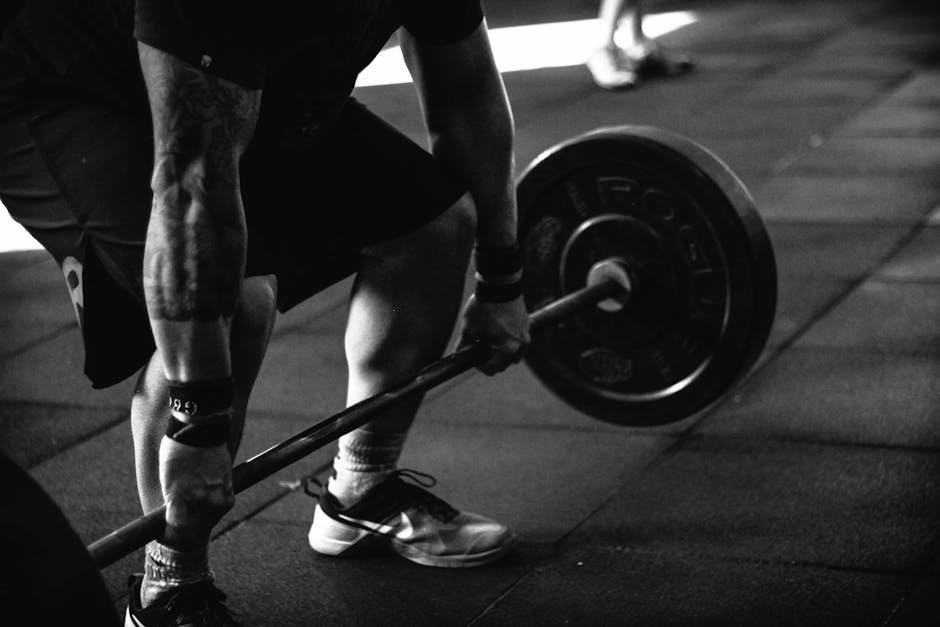
Pre-Season Weight Training Program (8-12 Weeks)
PDF-based pre-season basketball weight training programs typically span 8-12 weeks, focusing on building a foundation of strength and endurance before competition begins.
Phase 1: Hypertrophy & Endurance (Weeks 1-4)
PDF basketball weight training programs often initiate with a hypertrophy and endurance phase lasting 4 weeks. This foundational stage prioritizes increasing muscle mass and improving muscular endurance.
Exercises focus on higher repetition ranges – typically 10-12 reps per set – with moderate weight. The goal is not maximal strength, but rather building a solid base.
This phase prepares the athlete’s body for the more intense strength and power phases to follow, reducing injury risk and enhancing overall conditioning. Proper form is paramount during this period.
Focus on Muscle Building
A basketball weight training program PDF will emphasize muscle building during the initial phase. This involves selecting exercises that target major muscle groups used in basketball – legs, core, and upper body.
Compound movements like squats, deadlifts, and bench presses are central, alongside accessory exercises for balanced development.
The primary aim is to increase muscle fiber size (hypertrophy), providing a stronger foundation for subsequent power development. Nutrition, particularly protein intake, is vital to support muscle growth during this phase.
Rep Ranges and Sets
A typical basketball weight training program PDF for the hypertrophy phase prescribes rep ranges of 8-12 repetitions per set. This range effectively stimulates muscle growth while allowing for sufficient volume.
Generally, 3-4 sets per exercise are recommended, focusing on controlled movements and proper form.
Rest periods between sets should be around 60-90 seconds to allow for partial recovery and maintain exercise quality. Progressive overload – gradually increasing weight or reps – is key to continued progress.
Phase 2: Strength & Power (Weeks 5-8)
A basketball weight training program PDF will detail that this phase focuses on increasing maximal strength, vital for explosive movements. Weeks 5-8 shift towards lower rep ranges, typically 4-6 repetitions per set, utilizing heavier weights – around 85-90% of your one-rep max.
Maintain 3-5 sets per exercise.
Longer rest periods, 2-3 minutes, are crucial for full recovery between sets, enabling you to lift with maximum effort and build substantial strength gains.
Increasing Maximal Strength
A comprehensive basketball weight training program PDF emphasizes that increasing maximal strength is paramount for dominating on the court. This involves lifting the heaviest weight possible for a low number of repetitions, typically focusing on compound exercises.
Exercises like squats, deadlifts, and bench presses are key.
Progressive overload – gradually increasing weight – is essential. Prioritize proper form to prevent injury while maximizing strength development, translating to improved jumping ability and power.
Lower Rep Ranges, Higher Weight
A well-structured basketball weight training program PDF dictates utilizing lower repetition ranges – typically 3-6 reps – coupled with significantly higher weight during the strength phase. This approach directly targets maximal strength gains, crucial for explosive movements.
Focus on maintaining impeccable form throughout each set.
Adequate rest between sets (2-5 minutes) is vital for full recovery and optimal performance. This method builds the foundation for power development in subsequent phases.
Phase 3: Power & Speed (Weeks 9-12)
A basketball weight training program PDF for this phase emphasizes translating strength into explosive power and speed. Plyometrics – jump training – become central, alongside exercises focusing on the rate of force development.
Think box jumps, depth jumps, and medicine ball throws.
Lift lighter weights with maximal velocity. This phase bridges the gap between strength gains and on-court performance, enhancing agility and reactive ability for game-specific movements.
Plyometrics and Explosive Movements
A comprehensive basketball weight training program PDF will detail plyometrics as key for developing explosive power. These exercises, like box jumps and depth jumps, utilize the stretch-shortening cycle to enhance jump height and quickness.
Focus on minimizing ground contact time and maximizing effort.
Include medicine ball throws for upper body explosiveness. Proper form is vital to prevent injury; a PDF guide should illustrate correct technique for each movement, ensuring safe and effective training.
Focus on Rate of Force Development
A well-structured basketball weight training program PDF emphasizes rate of force development (RFD) – how quickly you can generate force. This is critical for first-step quickness, jumping, and reacting on the court.
Exercises should be performed with maximal intent, focusing on explosive contractions.
Olympic lifts, if properly coached, are excellent for RFD. The PDF should detail appropriate weight selection and progression to optimize power output and minimize injury risk, building a foundation for peak performance.

In-Season Weight Training Program (Maintenance)
Basketball weight training program PDFs for in-season focus on maintaining gains while managing fatigue; reduced volume and increased intensity are key components.
Maintaining Strength During Competition
Maintaining strength during the competitive season requires a strategic shift in your basketball weight training program, often detailed in PDF guides. The primary goal transitions from building strength to preserving it while minimizing fatigue and risk of injury.
Focus shifts towards higher intensity, lower volume workouts. This means fewer sets and reps, but with heavier weights, prioritizing compound movements. Prioritize exercises that directly translate to on-court performance. Adequate rest and recovery become even more critical, alongside proper nutrition, to support muscle repair and prevent overtraining.
Reduced Volume, Increased Intensity
A key component of an in-season basketball weight training program, often outlined in a PDF format, is a deliberate reduction in volume coupled with an increase in intensity. This approach safeguards against fatigue during games and practices.
Expect fewer total sets and reps per workout, but maintain or even slightly increase the weight lifted. This preserves strength gains without overtaxing the neuromuscular system. Focus on explosive movements and power exercises. Prioritize quality over quantity, ensuring proper form to minimize injury risk and maximize effectiveness.
Frequency and Exercise Selection
In-season basketball weight training programs, frequently distributed as PDF guides, typically recommend a reduced frequency of 2-3 sessions per week. This allows for adequate recovery amidst a demanding game schedule.
Exercise selection should prioritize maintaining strength and power. Focus on compound movements like squats, deadlifts, and bench press, alongside sport-specific exercises. Incorporate plyometrics for explosive power. Avoid introducing new, complex exercises during the season to minimize risk and maintain consistency;

Off-Season Weight Training Program (Rebuilding)
Basketball weight training PDF programs emphasize rebuilding during the off-season, addressing weaknesses and imbalances through a return to hypertrophy-focused training.
Addressing Weaknesses and Imbalances
Basketball weight training PDF programs designed for the off-season prioritize identifying and correcting individual player deficiencies. A comprehensive assessment reveals muscular imbalances, often stemming from dominant-side specialization during gameplay.
Targeted exercises, like unilateral movements (single-leg squats, dumbbell rows), are crucial for restoring symmetry and preventing injury. Focus shifts to strengthening supporting muscle groups often neglected during the competitive season.
This phase isn’t just about adding weight; it’s about building a robust foundation for future strength gains and optimizing movement patterns for peak performance.
Return to Hypertrophy Phase
Following the off-season’s corrective work, a basketball weight training PDF program will typically guide athletes back to a hypertrophy phase. This focuses on rebuilding muscle mass lost during the competitive season and preparing the body for increased intensity.
Moderate rep ranges (8-12) with controlled tempos are employed to stimulate muscle growth. Emphasis is placed on compound exercises – squats, deadlifts, bench press – to maximize overall development.
Proper nutrition is paramount during this phase, supporting muscle protein synthesis and recovery, setting the stage for subsequent strength and power work.

Key Exercises for Basketball Players
Basketball weight training PDF programs prioritize exercises like squats, deadlifts, lunges, bench press, and pull-ups to build strength and power for optimal performance.
Lower Body Exercises
Lower body strength is foundational in basketball, and basketball weight training PDF guides emphasize several key exercises. Squats (back, front, goblet) build overall leg power and stability. Deadlifts (conventional, Romanian) enhance posterior chain strength, vital for jumping and sprinting.
Various lunges (forward, reverse, lateral) improve single-leg strength, balance, and agility – crucial for navigating the court. These exercises, when incorporated into a structured program, directly translate to improved vertical jump, speed, and explosive movements during gameplay.
Squats (Back, Front, Goblet)
Squats are a cornerstone of any basketball weight training PDF program, building lower body strength and power. Back squats are foundational, targeting quads, glutes, and hamstrings. Front squats emphasize quad development and core stability, mimicking basketball stance.
Goblet squats, using a dumbbell or kettlebell, are excellent for beginners, promoting proper form and core engagement; Varying squat types ensures comprehensive leg development, enhancing jumping ability, agility, and overall athletic performance on the court.
Deadlifts (Conventional, Romanian)
Deadlifts, frequently detailed in basketball weight training PDF guides, are vital for developing posterior chain strength – hamstrings, glutes, and lower back. Conventional deadlifts build overall power and strength, crucial for explosive movements;
Romanian deadlifts (RDLs) focus on hamstring flexibility and strength, improving stride length and injury prevention. Incorporating both variations enhances athletic performance, providing the power needed for rebounding, sprinting, and powerful jumps essential in basketball.
Lunges (Forward, Reverse, Lateral)
Lunges, commonly featured in basketball weight training PDF programs, are foundational for building lower body strength and stability. Forward lunges mimic basketball’s running motion, enhancing stride power. Reverse lunges improve balance and control, vital for quick changes in direction.
Lateral lunges target adductors and abductors, crucial for lateral movement and defensive agility. Integrating all three variations develops well-rounded lower body strength, improving on-court performance and reducing injury risk, as detailed in comprehensive training resources.
Upper Body Exercises
Basketball weight training PDF guides emphasize upper body strength for shooting, passing, and rebounding. Bench Press (barbell or dumbbell) builds pushing power, essential for boxing out and finishing at the rim. Overhead Press enhances shoulder stability and shooting range of motion.
Pull-Ups/Chin-Ups develop pulling strength, vital for rebounding and controlling opponents. A balanced upper body program, often detailed in these PDFs, improves overall athleticism and contributes to a more powerful and efficient basketball player.
Bench Press (Barbell, Dumbbell)
Basketball weight training PDF resources consistently feature the Bench Press – both barbell and dumbbell variations – as a cornerstone exercise. It directly translates to increased upper body pushing strength, crucial for establishing position, boxing out opponents, and powerful finishes around the basket.
PDF guides often detail proper form and progressive overload strategies. Dumbbell variations enhance stability and address strength imbalances. Consistent bench pressing, as outlined in these programs, builds the power needed for dominant play.
Overhead Press (Barbell, Dumbbell)
Basketball weight training PDF programs prioritize the Overhead Press, utilizing both barbell and dumbbell options, to develop shoulder and upper body strength. This exercise is vital for shooting mechanics, passing range, and overall upper body power.
PDF guides emphasize controlled movements and proper technique to prevent injury. Dumbbell variations improve stability and address imbalances. Consistent overhead pressing, as detailed in these resources, builds the strength needed for a consistent and powerful offensive game.
Pull-Ups/Chin-Ups
Basketball weight training PDF resources consistently feature Pull-Ups and Chin-Ups as foundational upper body exercises. These build back and bicep strength, crucial for rebounding, post play, and finishing at the rim.
PDF guides often provide progressions for athletes unable to perform full pull-ups, such as assisted variations or negative reps. Mastering these exercises enhances overall upper body power and contributes to improved athletic performance on the basketball court, as detailed in comprehensive training programs.
Core Strength Training for Basketball
Basketball weight training PDF programs emphasize core stability for efficient movement, balance, and power transfer during jumps, cuts, and overall court agility.
Importance of Core Stability
Core stability is paramount in basketball weight training programs, often detailed in PDF guides, as it directly impacts athletic performance; A strong core acts as the foundational link between the upper and lower body, enabling efficient force transfer during dynamic movements like shooting, passing, and dribbling.
Enhanced core strength improves balance, reduces the risk of injuries, and allows players to maintain proper form under fatigue. PDF resources highlight exercises targeting various core muscles – rectus abdominis, obliques, and lower back – to build a robust and resilient core essential for success on the court.
Plank Variations
Basketball weight training programs, frequently found as PDF downloads, heavily incorporate plank variations to build core endurance and stability. Beyond the standard plank, progressions like side planks, plank with arm/leg lifts, and walking planks challenge the core in multiple planes of motion.
These variations, detailed in PDF guides, enhance functional strength crucial for basketball-specific movements. They improve anti-rotation and anti-extension capabilities, vital for maintaining balance and control during gameplay. Consistent plank work builds a solid core foundation, minimizing injury risk and maximizing athletic potential.
Rotational Core Exercises
Basketball weight training programs, often accessible as PDF resources, emphasize rotational core exercises to mimic the twisting and turning inherent in the sport. Russian twists with or without weight, medicine ball throws, and cable rotations are commonly included.
These exercises, detailed in PDF guides, develop power and control during movements like shooting, passing, and defensive slides. Strengthening the obliques and transverse abdominis improves stability and force transfer. A robust rotational core is essential for agility, preventing injuries, and enhancing overall basketball performance.

Sample 30-Day Workout Calendar
Basketball weight training program PDFs frequently include a 30-day calendar, detailing daily workouts with progressive overload for optimal strength and conditioning gains.
Weekly Schedule Overview
Basketball weight training program PDFs often structure the week with a blend of strength and conditioning. A typical schedule might include two to three weightlifting sessions focusing on major muscle groups.
These sessions are interspersed with speed, agility, and conditioning drills – crucial for basketball-specific movements. Rest days are strategically placed for recovery and injury prevention.
The PDF will detail specific exercises, sets, reps, and rest periods for each day, ensuring a balanced and progressive training load. Some programs incorporate plyometrics for explosive power.
Exercise Progression
A well-designed basketball weight training program PDF emphasizes progressive overload. This means gradually increasing the demands on your body over time. Initially, focus on mastering proper form with lighter weights.
As strength improves, the PDF will guide you to increase weight, reps, or sets. Variations of exercises are introduced to challenge muscles in new ways.
Progression also involves advancing from basic movements to more complex, sport-specific exercises, ultimately enhancing power and agility on the court; Consistent tracking is key.

Nutrition for Basketball Weight Training
Basketball weight training program PDFs often highlight the importance of a balanced diet with appropriate macronutrient ratios for optimal recovery and performance gains.
Macronutrient Ratios
Basketball weight training program PDFs consistently emphasize strategic macronutrient intake. Carbohydrates, typically 45-55% of total calories, fuel high-intensity workouts and replenish glycogen stores crucial for basketball’s demands.
Protein, constituting 25-35%, is vital for muscle repair and growth, supporting adaptations from weight training. Healthy fats, around 20-30%, contribute to hormone production and overall health.
Individual needs vary based on training intensity, body composition, and metabolic rate, so personalized adjustments are often recommended within these guidelines. Proper ratios maximize performance and recovery.
Importance of Hydration
Basketball weight training program PDFs universally stress the critical role of hydration. Intense training elevates sweat rates, leading to fluid and electrolyte loss, impacting performance and recovery.
Adequate water intake maintains blood volume, regulates body temperature, and transports nutrients efficiently. Dehydration can cause fatigue, muscle cramps, and reduced cognitive function – detrimental to basketball.
Consuming water before, during, and after workouts is essential. Electrolyte-rich beverages can further replenish lost minerals, optimizing hydration status and supporting peak athletic condition.

Injury Prevention & Recovery
Basketball weight training program PDFs emphasize proper form, warm-up routines, and cool-downs to minimize injury risk and promote effective muscle recovery.
Warm-up and Cool-down Routines
Basketball weight training program PDFs consistently highlight the significance of dynamic warm-ups before each session. These should include movements like leg swings, arm circles, and torso twists, preparing muscles for exertion.
Prioritizing a thorough warm-up increases blood flow and reduces the risk of strains. Conversely, cool-down routines, featuring static stretches held for 20-30 seconds, aid in muscle recovery and flexibility.
Effective cool-downs help to minimize post-exercise soreness and improve long-term athletic performance, as detailed in many comprehensive PDF guides.
Proper Form and Technique
Basketball weight training program PDFs universally emphasize mastering proper form before increasing weight. Incorrect technique dramatically elevates injury risk and hinders progress. Focus on controlled movements, engaging core muscles throughout each exercise.
Resources often include detailed visual guides and cues for exercises like squats, deadlifts, and bench presses. Prioritize quality over quantity; a lighter weight with perfect form is far more beneficial.
Seeking guidance from a qualified coach or referencing instructional videos within the PDF is crucial for safe and effective training.
Resources for Basketball Weight Training PDFs
Basketball weight training program PDFs are readily available online through platforms like LinkedIn Learning and various sports training websites, offering comprehensive guides.
Online Platforms and Websites
Numerous online resources provide basketball weight training program PDFs and related materials. LinkedIn Learning (formerly Lynda.com) offers comprehensive Power BI courses, though indirectly relevant for data analysis of training progress.
Websites specializing in sports performance frequently host downloadable PDF guides detailing year-round programs, focusing on strength, power, and agility. These resources often include exercise descriptions with photographs, mirroring content found in dedicated athletic training books.
Searching for “basketball weight training PDF” yields a variety of options, from collegiate-level programs to those designed for younger athletes, ensuring a tailored approach to fitness.
Books and Publications
Dedicated basketball training books often include comprehensive weight training programs, sometimes available as supplemental PDF materials. These publications feature detailed exercise descriptions and photographic guides, mirroring techniques used by athletes globally.
Many books guarantee performance improvements through year-round, sport-specific training regimens. They emphasize the importance of a structured approach, covering strength, flexibility, and core stability.
While Power BI isn’t directly related, analyzing training data from these programs can be enhanced with such tools. Publications provide a solid foundation for building a personalized program.